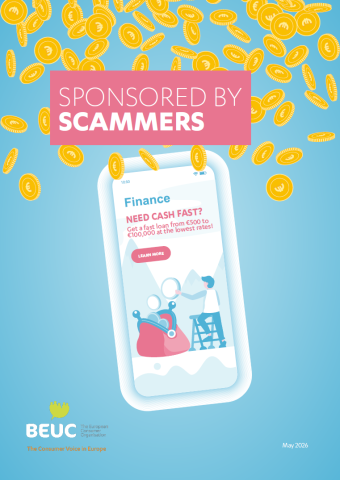

Sponsored by Scammers
Published on 21.05.2026
About this publication
Consumers spend more time online and increasingly rely on digital payment services in their daily lives. As their digital presence grows, so do fraudulent practices, with online advertising emerging as a major vector for scams. Whether watching videos, following friends, scrolling or reading the news, consumers are routinely exposed to increasingly sophisticated fraud schemes, leading not only to financial harm – i.e. in 2024, consumers suffered financial losses up to EUR 4.2 billion – but also to a loss of trust in digital and financial markets.
Under the EU’s Digital Services Act (DSA), online platforms are required to mitigate risks stemming from fraudulent contents by providing (among other things) transparency about the ads and advertisers on their interfaces, easy ways to report scams and by ensuring that scammers are removed from the platform.
Between December 2025 and March 2026, BEUC and 13 consumer organisations conducted large-scale evidence-gathering in 13 countries. The findings show that financial scams remain widespread on Meta, TikTok, and Google, and that platforms systematically fail to take effective corrective actions. In many cases, consumer groups found alarming discrepancies between what platforms claim to do and the reality of what is happening on their interfaces. Therefore, consumer organisations filed this complaint with the European Commission and the competent national authorities in May 2026 and highlighted breaches of Art. 16, 20, 23, 24, 25, 34, 35 and 39 DSA.
Download:
Image