
Latest News
Logo

Position papers
Available in
English
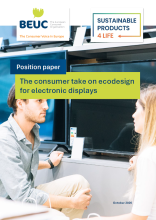
Over the years, electronic displays have grown in size and energy consumption while homes and living spaces have remained the same. This trend is expected to continue in the coming years, further increasing the energy demand of these screens. In fact, televisions and other electronic displays already account for 10% of household electricity consumption.
With this context, the European Commission is developing a proposal on electronic displays in the form of a delegated act under the Ecodesign for Sustainable Products Regulation (ESPR). Such regulation allows the Commission to set product-specific requirements, and has already improved product sustainability and efficiency. For instance, European households can save €650 every year on their energy bills thanks to more efficient appliances, while Ecodesign rules have also co made smartphones easier to repair and given consumers more information at the point of purchase.
With this context, the European Commission is developing a proposal on electronic displays in the form of a delegated act under the Ecodesign for Sustainable Products Regulation (ESPR). Such regulation allows the Commission to set product-specific requirements, and has already improved product sustainability and efficiency. For instance, European households can save €650 every year on their energy bills thanks to more efficient appliances, while Ecodesign rules have also co made smartphones easier to repair and given consumers more information at the point of purchase.
Vacancy
Available in
English
BEUC is looking for technical experts in the areas of Ecodesign and Energy Labelling to support European consumer organisations in the EU policy-making process. Experts will provide technical and scientific input into preparatory studies and draft measures discussed at EU level.
News
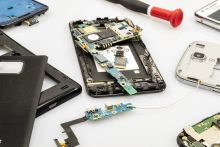
As of 31 July 2026, consumers will be able to use their phones, tablets, washing machines, or dishwashers longer thanks to easier repairs.

Press releases
Available in
English
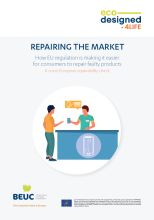
Smartphones have become easier to repair thanks to EU regulation, according to a new market check carried out by consumer groups across Europe. By the same token, vacuum cleaners, which are not subject to the same regulation, remain more difficult to repair.
Position papers
Available in
English
BEUC welcomes the opportunity to provide suggestions to the European Commission’s upcoming Citizens Omnibus, which aims to simplify EU rules so this process improves citizen’s lives concretely when dealing with cross-border situations.
In this document, BEUC focuses mainly on improving the consumer experience in EU cross-border situations. For more recommendations about how the EU can continue improving consumer lives across Member States, BEUC’s view on the Consumer Agenda 2025-2030 is available here.
In this document, BEUC focuses mainly on improving the consumer experience in EU cross-border situations. For more recommendations about how the EU can continue improving consumer lives across Member States, BEUC’s view on the Consumer Agenda 2025-2030 is available here.
Press releases
Available in
English
BEUC - with 12 member organisations from 11 countries - today filed a complaint with the European Commission and European consumer protection authorities against ENGIE, Eni Plenitude, Shell, and TotalEnergies for misleading green claims.