
Latest News
Logo

Press releases
Available in
English
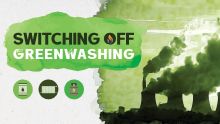
BEUC - with 12 member organisations from 11 countries - today filed a complaint with the European Commission and European consumer protection authorities against ENGIE, Eni Plenitude, Shell, and TotalEnergies for misleading green claims.
Press releases
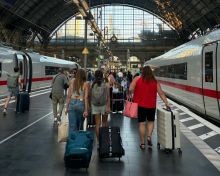
The European Commission today published its Passenger Package, an ambitious proposal to encourage consumers to take the train via easier booking and strengthened passenger rights.
Position papers
Available in
English
EU energy and climate legislation sets the pace for decarbonising our economy. Some of these laws contain EU targets. The governance law helps Member States deliver these targets and defines reporting obligations. This should result in consumers benefitting from lower bills, a better quality of life, and a future for our planet. Practically this means more renewable energy, less imports of volatile fossil fuels, continuous efforts to use energy more efficiently, the availability of sustainable products that can be recognised via clear labels, a variety of green mobility choices, and a future where healthy and sustainable foods are accessible and affordable.

Position papers
Available in
English
Together with european businesses, major cities, and civil society, we express our strong support for the EU Clean Corporate Vehicles Regulation. This initiative represents a huge opportunity for a smart, green industrial and social policy for Europe.
Tools
Available in
English
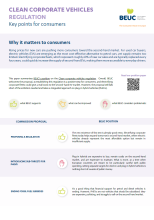
Rising prices for new cars are pushing more consumers toward the second-hand market. For used car buyers, electric vehicles (EVs) are emerging as the most cost-effective alternative to petrol cars, yet supply remains too limited. Electrifying corporate fleets, which represent roughly 60% of new car sales and are typically replaced every four years, could quickly increase the supply of second-hand EVs, making them more accessible to everyday drivers.
Tools
Available in
English
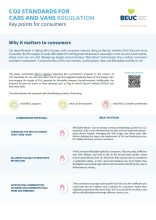
Car electrification is taking off in Europe, with consumer interest rising as electric vehicles (EVs) become more accessible. But the supply of small, affordable EVs still lags behind demand, especially on the second-hand market, where most cars are sold. Weakening targets and promoting “alternative” technologies thus confuse consumers and deter investments. It slows the flow of EVs into markets, pushing back clean and affordable mobility for all.
Tools
Available in
English
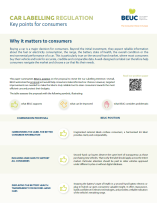
Buying a car is a major decision for consumers. Beyond the initial investment, they expect reliable information about the fuel or electricity consumption, the range, the battery state of health, the overall condition or the environmental performance of a car. This is particularly true on the second-hand market, where most consumers buy their vehicle and look for accurate, credible and comparable data. A well-designed car label can therefore help consumers navigate the market and choose a car that fits their needs.
Press releases
Available in
English
The European Commission today published its Automotive Package which will revise the car CO2 emissions target along with setting new electrification goals for large corporate fleets and incentivising the production of small electric cars in Europe.

Press releases
Available in
English
Following a complaint by BEUC, the European Consumer Organisation, 21 major airlines have committed to stop using claims that mislead consumers about the real impact of flying on the environment. This was announced by the European Commission today, concluding a 1.5-year investigation by national consumer authorities.
BEUC launched the action in June 2023 with 23 of its member organisations and kept monitoring the market since then. An evaluation two years on, in June 2025, showed that airlines’ greenwashing was still rife despite some improvements
BEUC launched the action in June 2023 with 23 of its member organisations and kept monitoring the market since then. An evaluation two years on, in June 2025, showed that airlines’ greenwashing was still rife despite some improvements