
Consumer groups file greenwashing complaint against ENGIE, Eni Plenitude, Shell, and TotalEnergies
Published on 16.06.2026
About this publication
BEUC - with 12 member organisations from 11 countries [1] - today filed a complaint with the European Commission and European consumer protection authorities against ENGIE, Eni Plenitude, Shell, and TotalEnergies for misleading green claims.
These misleading claims can be illegal under EU consumer law.[2] Greenwashing slows the energy transition, keeping consumers locked into volatile fossil fuel prices, with consumers already struggling in yet another energy crisis. It also allows companies to charge consumers a premium for ‘green’ products,[3] costing consumers and unfairly disadvantaging companies making genuine sustainability efforts.
The claims include:
-
Generic green claims and sustainability ‘halo’ claims that the targeted companies use to promote ‘green’ energy products that include fossil gas. The companies also highlight their ‘green’ image based on renewable energy investments, despite these being marginal to their overall business and not phasing out fossil fuels.
-
Future environmental performance claims about goals like net-zero emissions, despite continuing to invest heavily in fossil fuel expansion. Carbon-offsetting claims whereby companies (e.g. ENGIE) argue that emissions from gas are compensated by investing in climate-related projects elsewhere (e.g. forest plantations), which are scientifically invalid.
-
Misleading comparative claims (e.g. by TotalEnergies) that advertise fossil gas as green or having lower CO2 emissions than other fossil fuels. This omits to mention that fossil gas still emits a lot of CO2 when burned, and that its production and transportation results in methane leaks, a very potent greenhouse gas. Together, this can have a similar or greater climate impact than coal or oil.
BEUC Director General Agustín Reyna said: “Some of Europe's leading energy companies are misleading consumers about their real climate impact. This greenwashing makes it hard for consumers to tell which energy providers are genuinely moving away from fossil fuels and those that aren’t or are doing so too slowly. Consumers are also paying a premium for green energy offers that are green in name only.
“This harms the environment but also creates uncertainty that discourages consumers from switching to clean tech, like heat pumps or solar panels. Ultimately, greenwashing delays the energy transition, locking consumers into expensive and volatile fossil fuel prices. This when consumers are paying the bill for yet another fossil fuel crisis. We expect authorities to intervene to stop these misleading practices and begin a sector-wide investigation. These companies should also reimburse consumers who were charged a ‘green’ premium or were sold fossil fuel products on the back of misleading claims”.
We call on the authorities to:
-
Require the targeted traders to stop using misleading green marketing claims. They should monitor the use of these claims and impose fines on the companies if they continue to use them.
-
Request the targeted companies to compensate consumers for charging higher prices for ‘green’ energy contracts or fossil-fuel products based on misleading green claims.
-
Inform consumers that, despite companies’ investments in climate-protection projects, these should not be presented as offsetting or compensating the company’s emissions or that of its fossil-fuel based products.
Our research reveals that greenwashing is a sector-wide issue, which is why our members have also submitted complaints in parallel targeting energy traders operating at national level.
Background
Consumers are worried about the significant consequences of climate change and increasingly want to act. According to a 2023 BEUC consumer survey, 79% of respondents reported making efforts to reduce their environmental footprint, including in relation to energy consumption, and are paying closer attention to green claims. In parallel, energy providers are increasingly using green marketing to influence consumer choices.
As a highly polluting sector, energy providers must exercise caution when making sustainability claims. Their activities continue to have a substantial negative impact on the environment, as they remain heavily reliant on fossil fuels, which are a major contributor to climate change.
Read more
-
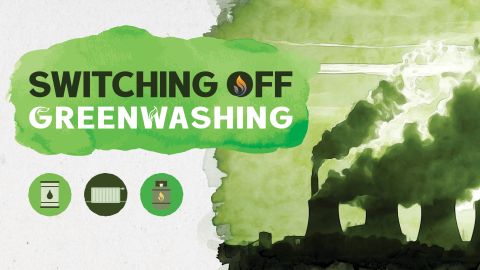
Report: Switching off greenwashing
-
About the action
[1] CECU (Spain), CLCV and Que Choisir Ensemble (France), Consumentenbond (The Netherlands), Consumatori Italiani per l'Europa (Italy), DECO (Portugal), EKPIZO and KEPKA (Greece), Federacja Konsumentów (Poland), Forbrugerrådet Tænk (Denmark), Spoločnosť ochrany spotrebiteľov (Slovakia), Verein für Konsumenteninformation (Austria), and BEUC for Belgium.
[2] The EU’s Unfair Commercial Practices Directive bans false or misleading claims or omitting key information, whilst the Empowering Consumers in the Green Transition Directive bans generic green claims, as well as offsetting claims on products.
[3] E.g. in the case of ENGIE it can vary from €0.75 to €15 p/month depending on the share of green gas included in the offer, plus a fee of €3 p/month. 100 litres of TotalEnergies Bio Premium Thermogreen oil is €17 more expensive than the standard one. The Danish Shell Eco Ultra Oil is nearly €7 more p/1,000 litres.
Download:
Image
16.06.2026
- PDF Document - 138.43 KB
Available in English