
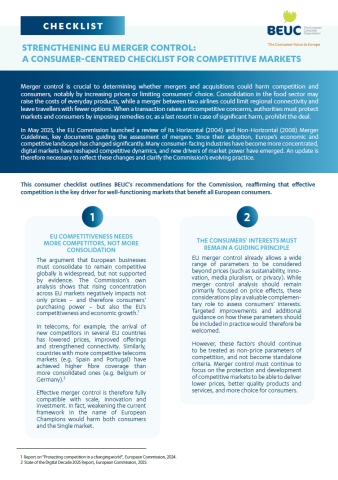
Strengthening EU merger control: a consumer-centred checklist for competitive markets
Published on 12.03.2026
About this publication
Merger control is crucial to determining whether mergers and acquisitions could harm competition and consumers, notably by increasing prices or limiting consumers’ choice. Consolidation in the food sector may raise the costs of everyday products, while a merger between two airlines could limit regional connectivity and leave travellers with fewer options. When a transaction raises anticompetitive concerns, authorities must protect markets and consumers by imposing remedies or, as a last resort in case of significant harm, prohibit the deal.
In May 2025, the EU Commission launched a review of its Horizontal (2004) and Non-Horizontal (2008) Merger Guidelines, key documents guiding the assessment of mergers. Since their adoption, Europe's economic and competitive landscape has changed significantly. Many consumer-facing industries have become more concentrated, digital markets have reshaped competitive dynamics, and new drivers of market power have emerged. An update is therefore necessary to reflect these changes and clarify the Commission’s evolving practice.
This consumer checklist outlines BEUC's recommendations for the Commission, reaffirming that effective competition is the key driver for well-functioning markets that benefit all European consumers.
1. EU competitiveness needs more competitors, not more consolidation
2. The consumers’ interests must remain a guiding principle
3. Measurable effects of mergers should be prioritised to ensure effective competition
4. Competition authorities should have the right tools and powers for reviewing mergers
Download:
Image
12.03.2026
- PDF Document - 182.87 KB
Available in English