
What is missing for collective redress to deliver for consumers?
Published on 07.11.2025
About this publication
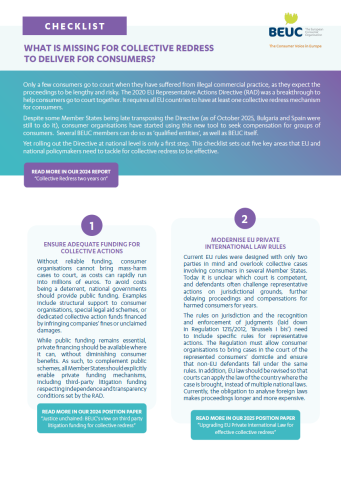
Only a few consumers go to court when they have suffered from illegal commercial practice, as they expect the
proceedings to be lengthy and risky. The 2020 EU Representative Actions Directive (RAD) was a breakthrough to
help consumers go to court together. It requires all EU countries to have at least one collective redress mechanism
for consumers.
Despite some Member States being late transposing the Directive, consumer organisations have started using this new tool to seek compensation for groups of consumers. Several BEUC members can do so as ‘qualified entities’, as well as BEUC itself.
Yet rolling out the Directive at national level is only a first step. This checklist sets out five key areas that EU and
national policymakers need to tackle for collective redress to be effective.
1. Ensure adequate funding for collective actions
2. Modernise EU private international law rules
3. Shift the burden of proof and ease access to evidence
4. Facilitate collective redress for non-material harm
5. Bridging private and public enforcement
Download:
Image
07.11.2025
- PDF Document - 304.03 KB
Available in English