Unbottling greenwashing
Unbottling greenwashing
Why did BEUC filed a complaint about misleading recyclability claims on bottled water products to EU authorities?
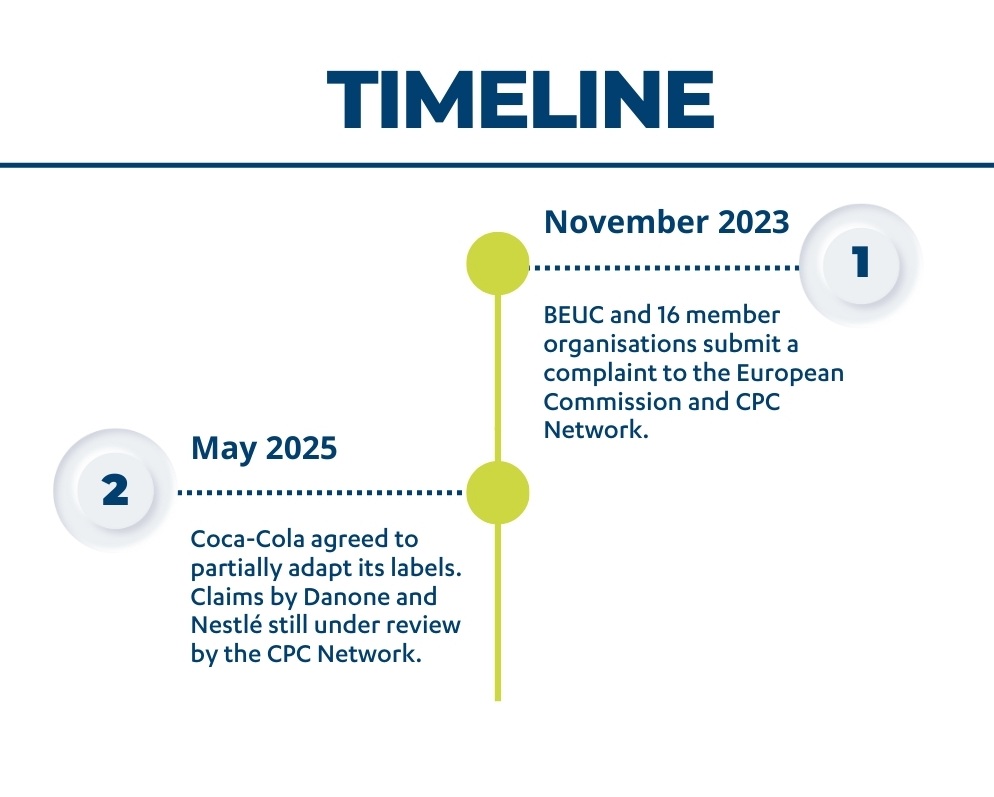
The European Consumer Organisation (BEUC), 13 of its members and other consumer organisations filed a complaint to EU authorities on 7 November 2023 about misleading recyclability claims on bottled water products marketed by major drinking water traders, such as Coca-Cola, Danone and Nestlé Waters/Nestlé. According to BEUC’s analysis, such claims do not comply with EU rules on unfair commercial practices.
What is BEUC complaint against drinking water traders based on?
BEUC’s complaint identified three key claims of concern:
-
“100% recyclable”: This ambiguous term depends on many factors such as the available infrastructure to collect material, the effectiveness of the sorting process, or appropriate recycling processes. The recycling rate for PET beverage bottle bodies is estimated to be only 55% in the EU and the chance of it becoming a bottle again around 30%.
-
“100% recycled”: This claim wrongly implies the full bottle is made entirely from recycled materials. The fact is that bottle lids cannot be made of recycled materials by EU law and labels are rarely made from recycled material either. In addition, adding virgin plastic (i.e., non-recycled plastic) to the body of the bottle is also a common practice.
-
Use of green imagery: Closed loops, green logos or nature images are used for branding many water bottles across Europe. They prompt the false idea of environmental neutrality, endless plastic circularity and may even give the impression that the bottles would have a positive impact on the environment.
Following the complaint, Coca-Cola and Nestlé agreed to partially adapt their labels, while the claims used by Danone remain under review by the CPC Network.
What is the real impact on consumers?
Using “100% recycled” or “100% recyclable” messages, as well as nature images and green visuals that suggest plastic is environmentally friendly, misleads consumers. There is no guarantee that plastic bottles will be fully recycled once they are disposed of, which undermines consumers’ understanding of the real environmental impact of these products.
Which BEUC members and consumer organisations took part in this action?
The following BEUC members took part in this action:
EKPIZO and KEPKA (Greece), Association Consommation, Logement et Cadre de Vie (CLCV-France), Consumentenbond (The Netherlands), CECU (Spain), Zveza Potrošnikov Slovenije (ZPS – Slovenia), Tudatos Vásárlók Egyesülete (TVE-Hungary), DECO (Portugal), Асоциация Активни потребители/ Bulgarian National Consumer Association (BNAAC – Bulgaria), Federacja Konsumentów (Poland), Verein für Konsumenteninformatiwon (VKI, Austria), Spoločnosť ochrany spotrebiteľov (S.O.S - Slovakia) and Kuluttajaliitto ry (Finland).
The following consumer organisations also supported the action:
Altroconsumo (Italy) and Organización de consumidores y usuarios (OCU).
This action also benefitted from the technical expertise from ClientEarth and ECOS.
The European Consumer Organisation (BEUC) called on the European Commission and the Consumer Protection authorities to launch an investigation into misleading recyclability claims used by bottled water traders and to ensure that consumers were no longer misled by such practices.
In particular, BEUC called on the CPC to take the following actions:
-
Start a coordinated enforcement action and publish a joint position.
-
Request traders to stop misleading consumers by using such claims. Specifically:
-
Traders should stop using ambiguous language relating to recyclability, including “recyclable” and/or “100% recyclable”. Instead, traders should provide clear information on how consumers should correctly dispose of packaging in the market where the product is sold.
-
Where the product contains recycled plastic and traders choose to include this information on product labels, traders should be clear about the quantity of recycled material in the product as a whole, acknowledging all components.
-
Information about recycling provided should not imply that plastic beverage bottles have no impact on the environment or that they are otherwise sustainable. Circular imagery and generic environmental claims, statements, and imagery on labels and in accompanying advertising should not be permitted
-
- News (29 June 2026): Major step against plastic bottle greenwashing as French court condemns Volvic
- Press release (6 May 2025): Coca-Cola promises to tackle greenwashing following BEUC complaint
- Press release (7 November 2023): Consumer groups launch EU-wide complaint against major water bottle producers for greenwashing
- Report with main findings and conclusions (November 2023)
- Letter to the CPC (November 2023)
- Targeted companies & identified labels (November 2023)
- Study accompanying the external alert submitted by BEUC to the CPC Network (November 2023)
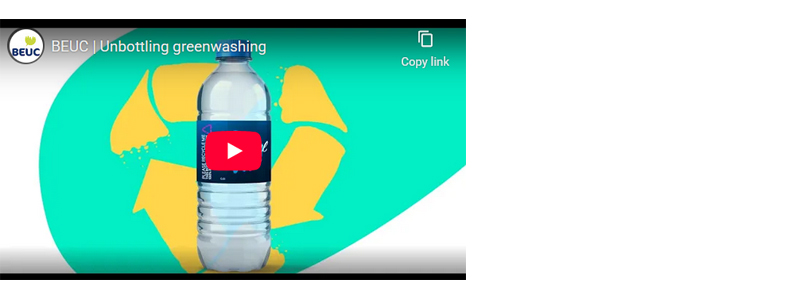
- Video, Unbottling greenwashing (November 2023)
Greenwashing : Volvic condamnée pour les mentions « neutre en carbone » et « 100 % recyclée » sur ses bouteilles d’eau
Le Monde (29 June 2026)
“En novembre 2023, CCLV et 12 associations membres du Bureau européen des unions de consommateurs ont signalé à la Commission européenne et au réseau des autorités de protection des consommateurs des allégations commerciales trompeuses sur la recyclabilité des bouteilles d’eau de grandes marques comme Danone, Coca-Cola et Nestlé Waters.”
Coca-Cola and Nestle accused of misleading eco claims
BBC News (07 November 2023)
“Companies are accused of greenwashing when they brand something as more eco-friendly, green or sustainable than it really is. It can mislead consumers who hope to help the planet by choosing those products.”
Drinks firms face EU-wide complaint over plastic bottle recycling claims
The Guardian (7 November 2023)
“The Bureau Européen des Unions de Consommateurs (BEUC) said claims that water bottles from brands owned by Coca-Cola, Danone and Nestlé are “100% recyclable” or “100% recycled” are misleading because recycling rates are far lower in practice and bottles contain items that cannot be made from recycled material.”
Coca-Cola, Danone and Nestle accused of 'misleading' shoppers over bottle recycling claims
Sky News (07 November 2023)
“Ursula Pachl, deputy director general of BEUC, said consumers "increasingly want to make the most sustainable choice", but are "bombarded with incorrect and deceptive claims".”
La OCU y asociaciones de otros 12 países denuncian en Bruselas a los envasadores de botellas de agua por ecopostureo
El País (07 November 2023)
“Las entidades de consumidores piden que se retiren de los envases afirmaciones exageradas como que son 100% reciclables y recicladas en una industria que produce millones de
de toneladas de residuos"
Recyclage des bouteilles en plastique : des associations de consommateurs portent plainte à Bruxelles
Euractiv France (07 November 2023)
“ L’industrie des boissons a recours à des allégations de recyclabilité qui, selon nos recherches, sont trop vagues, inexactes et/ou insuffisamment justifiées"
100 procent gerecycleerde plastic flessen? Dat is consumentenmisleiding
De Standaard (07 November 2023)
“Er bestaat geen enkele garantie dat een fles volledig wordt gerecycleerd wanneer die in de vuilnisbak is beland. Deze greenwashing moet stoppen.”
Afinal, as garrafas de plástico não são 100% recicláveis? Consumidores apresentam queixa
Azul Público (07 November 2023)
"“Seja na compra de roupas novas, seja na abertura de uma conta num banco ou na compra de garrafas de água, os consumidores querem cada vez mais fazer a escolha mais sustentável e buscam informações credíveis para isso. No entanto, eles são bombardeados com afirmações incorrectas e enganosas, por isso não sabem em qual afirmação ou rótulo confiar”, refere Ursula Pachl, vice-directora do BEUC."
Contact Card
Team Consumer Redress
The European Consumer Organisation
Europäischer Verbraucherverband
Bureau Européen des Unions de Consommateurs
Tel:
E-mail:

Alexandre Biard
Manager, Enforcement, Competition and Consumer rights

Pauline Constant
Director, Communications