
Sponsored by Scammers
Sponsored by Scammers
Why did BEUC file a complaint against Meta, TikTok and Google under the Digital Services Act?
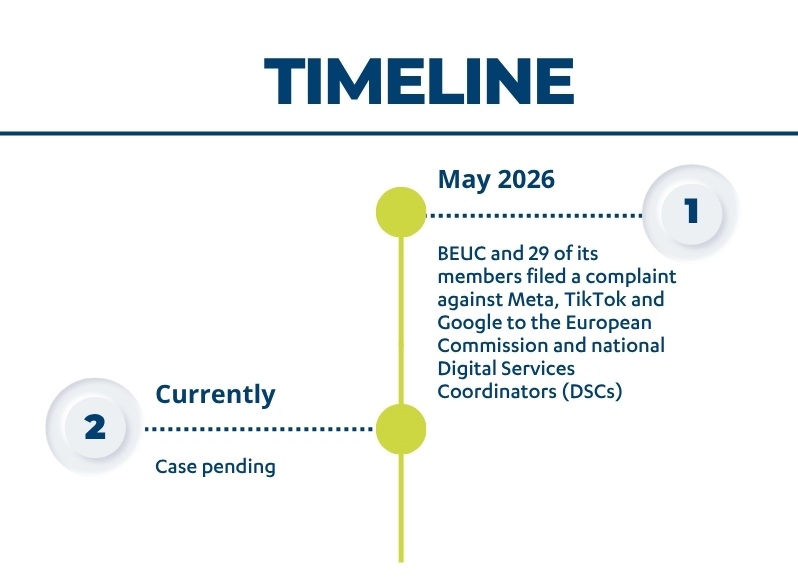
The European Consumer Organisation (BEUC) filed a complaint against Meta, TikTok and Google on 21 May 2026 with the European Commission and the competent national Digital Services Coordinators together with 29 members across 27 countries.
Under the Digital Services Act (DSA), Meta, TikTok and Google are required to have effective mechanisms in place to fight fraudulent ads and reduce the risks to consumers. However, our evidence gathering shows that Meta, TikTok and Google not only fail to pro-actively remove fraudulent ads but also do little when notified about such scams.
This is a breach of the EU’s Digital Services Act and it is essential to hold Meta, TikTok and Google accountable. If they fail to address the financial scams circulating on their platforms, fraudsters will continue to reach millions of European consumers daily, leaving people at risk of losing hundreds to thousands of euros to fraud.
What is BEUC’s complaint against Meta, TikTok and Google based on?
BEUC’s complaint against Meta, TikTok and Google is based on large-scale evidence gathering conducted between December 2025 and March 2026 by BEUC and 13 consumer organisations. The findings show that financial scams remain widespread on Meta, TikTok, and Google, and that platforms systematically fail to take effective corrective actions.
In total, we flagged 893 fraudulent ads across 13 countries that were active on either Meta, TikTok or Google.
In a nutshell, consumer groups found that:
-
Meta rejected nearly 43% of the submitted ads.
-
TikTok only removed 21% of the submitted ads. In 37% of the cases, TikTok claimed that the ad was removed before they could review it.
-
Google removed 60% of the submitted ads.
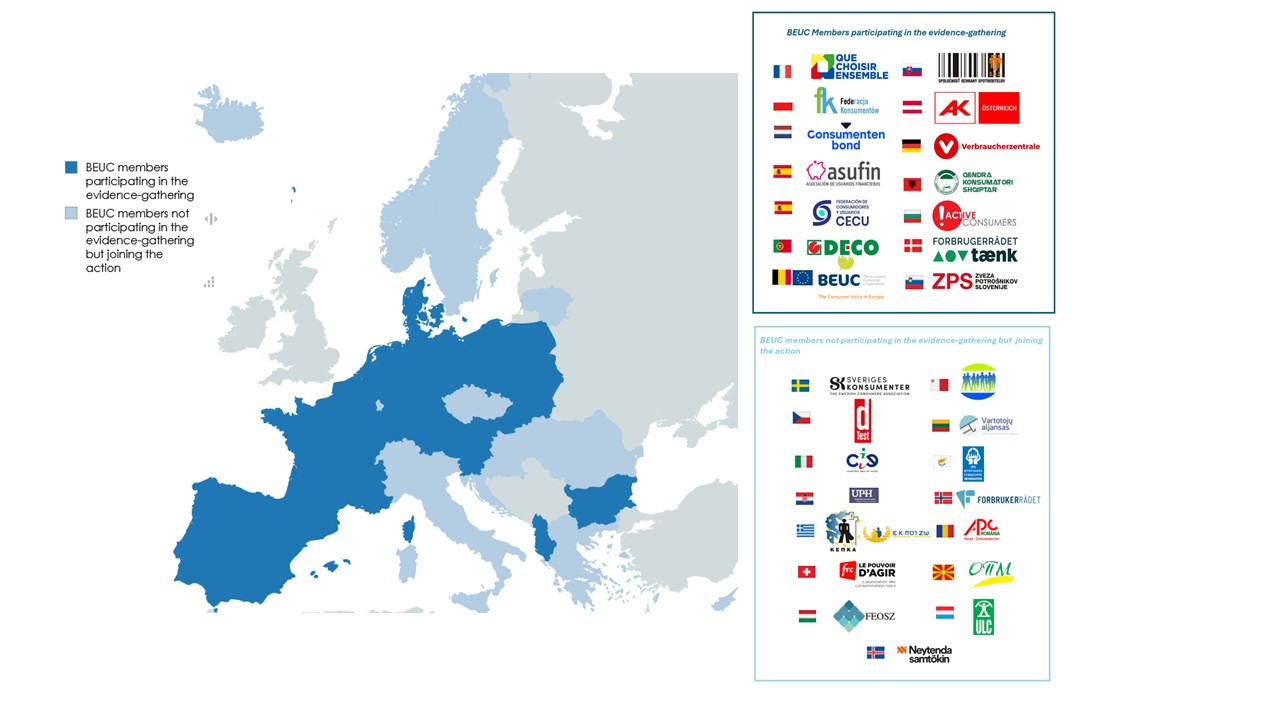
Consumer groups participating in the evidence-gathering were: Асоциация Активни потребители (Bulgaria), Arbeiterkammer (Austria), ASUFIN (Spain) and Federación de Consumidores y Usuarios – CECU (Spain), Consumentenbond (Netherlands), DECO (Portugal), Federacja Konsumentów (Poland), Forbrugerrådet Tænk (Denmark), Qendra Konsumatori shqiptar (Albania), Que Choisir Ensemble (France), Spoločnosť ochrany spotrebiteľov (S.O.S.) (Slovakia), Verbraucherzentrale Bundesverband – vzbv (Germany), Zveza Potrošnikov Slovenije – ZPS (Slovenia) and BEUC (for Belgium).
In addition, the following BEUC members have supported the action: ACR Malta (Malta), Asociatia Pro Consumatori – APC (Romania), Consumatori Italiani per l'Europa (CIE) (Italy), dTest (Czech Republic), EKPIZO and KEPKA (Greece), Fédération romande des consommateurs (Switzerland), Fogyasztóvédelmi Egyesületek Országos Szövetsége – FEOSZ (Hungary), Forbrukerrådet (Norway), Kypriakos Syndesmos Katanaloton (Cyprus), Neytendasamtökin - NS (Iceland), Organizacija na potrosuvacite na Makedonija – OPM (Macedonia), Sveriges Konsumenter (Sweden), Union Luxembourgeoise des Consommateurs – ULC (Luxembourg), Unija potrosaca Hrvatske (Croatia), and Vartotojų aljansas (Lithuania).
What is BEUC proposing in its complaint against Meta, TikTok and Google?
As a solution, the European Consumer Organisation (BEUC) calls on the European Commission and national Digital Services Coordinators (DSCs) to investigate the measures taken by Meta, TikTok, and Google to mitigate systemic risks related to financial scam and require them to comply with the Digital Services Act (DSA).
Specifically, consumer organisations call on the European Commission and national Digital Services Coordinators (DSCs) to:
- Launch, or where applicable accelerate, investigations into Meta, TikTok, and Google's DSA compliance and the measures taken by these platforms to mitigate risks related to financial scams.
- Require Meta, TikTok, and Google to bring their practices into immediate compliance with the DSA.
- Impose fines and, where appropriate, periodic penalty payments in cases of continued non-compliance.
Where Meta, TikTok and/or Google propose commitments to change their practices, the Commission should also ensure that interested third parties are given a meaningful opportunity to submit their views on those commitments.
- Press release: Consumer groups file complaints against Meta, TikTok and Google for failing to protect consumers against financial scams, 21 May 2026
- Report and annex: Sponsored by Scammers, May 2026
- Two-pager: Sponsored by Scammers, May 2026
- Letter to the European Commission: Consumer groups file DSA complaints against Meta, TikTok and Google for failing to curb financial scams, May 2026
- Letter to Institut belge des services postaux et des télécommunications (IBPT): Consumer Groups file DSA complaints against Meta, TikTok and Google for failing to curb financial scams, May 2026
Google, Meta, TikTok hit by EU consumer complaints about handling of financial scams
Reuters (21 May 2026)
Alphabet's Google, Meta Platforms and TikTok were hit with complaints from European Union consumer groups on Thursday for allegedly failing to protect users from financial scams on their platforms, putting them at risk of regulatory fines.
Commission urged to probe Meta, TikTok and Google over scam ads
Euractiv (21 May 2026)
Consumer groups' complaint records nearly 900 financial scam ads suspected of breaching DSA
Meta, TikTok, Google fail to tackle scam ads despite EU law, consumer groups say
MLex (21 May 2026)
Meta Platforms, TikTok and Google are failing to adequately tackle fraudulent financial advertising on their platforms despite obligations under the EU’s Digital Services Act, according to complaints by European consumer organization BEUC and 29 consumer groups.
Arnaques financières en ligne : le Beuc attaque Meta, Google et TikTok
Le Soir (21 May 2026)
L’organisation européenne des consommateurs dénonce l’inaction des plateformes face à l’avalanche de publicités frauduleuses pour des produits financiers bidon. Une plainte a été déposée auprès de la Commission européenne et dans treize Etats, dont la Belgique.
Verbraucherschützer werfen Plattformen betrügerische Werbung vor
Handelsblatt (21 May 2026)
Google, Meta und Tiktok sollen ihre Nutzer nicht vor Fakeshops und unseriösen Coachingangeboten schützen. Verbrauchervertreter fordern die EU-Kommission auf, Strafen zu verhängen.
Los consumidores europeos denuncian a Meta, TikTok y Google por la desprotección frente al fraude financiero
Cinco Días (21 May 2026)
Entre diciembre de 2025 y marzo de 2026, denunciaron cerca de 900 anuncios sospechosos de infringir la legislación de la UE
Contact Card
Communications Department
The European Consumer Organisation
Europäischer Verbraucherverband
Bureau Européen des Unions de Consommateurs
Tel:
E-mail:

Alexandre Biard
Manager, Enforcement, Competition and Consumer rights

Sandra Post
Communications Officer