
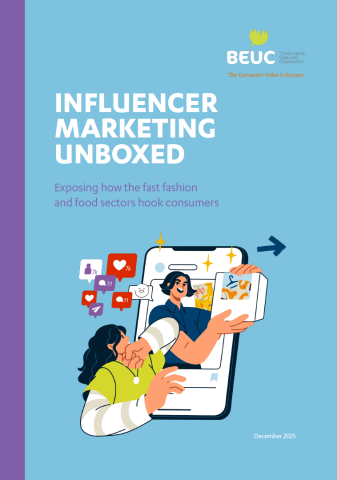
Influencer Marketing Unboxed: Exposing how the fast fashion and food sectors hook consumers
Published on 17.12.2025
About this publication
Influencer marketing is everywhere and unavoidable for anyone on social media due to the high volume of content and boundless creativity of social media influencers. Between March and September 2025, 14 BEUC consumer organisations from 12 countries monitored about 650 posts and videos of social media influencers on TikTok, Instagram, YouTube and Snapchat.
Although influencer marketing is present in nearly all sectors, this evidence-gathering focused on posts and videos promoting unhealthy food advertising and fast fashion as they are sectors where consumers are likely to be particularly at risks. Evidence confirms the widespread use of hidden advertising practices and how influencers appeal to emotions to shape consumers’ preferences. It also shows how brands use influencer marketing to give a positive spin to their reputation in the eyes of consumers, in particular the youngest ones.
As we identified in 2023, current EU law is only partially able to tackle the problems posed by influencer marketing and needs to be updated.1 It must clarify the responsibilities of the different actors operating in the influencer marketing environment - from influencers and their agencies to brands and online platforms. This report provides additional evidence supporting ongoing policy discussions at EU and national level. This is particularly the case for the EU Digital Fairness Act and the evaluation of the Audiovisual Services Media Directive, both expected in 2026.
Download:
Image
17.12.2025
- PDF Document - 5.1 MB
Available in English