
Food and fast fashion influencers: Europe-wide stocktaking proves need to protect consumers
Published on 17.12.2025
About this publication
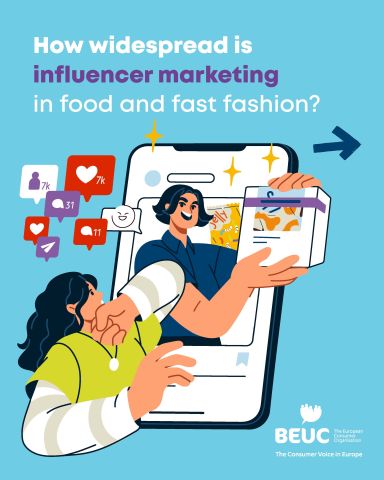
Evidence from posts of social media influencers gathered by consumer groups around Europe confirms widespread hidden advertising and appeal to emotions to shape consumers’ preferences and behaviour, in particular among the youngest ones. The European Consumer Organisation BEUC and its members call on the EU to urgently rein in influencer marketing by updating EU law. The EU must prevent influencers from promoting unhealthy foods to protect the health of young generations. This is particularly worrying at a time when one in three children in Europe live with overweight or obesity.[1]
Between March and September 2025, 14 BEUC consumer organisations from 12 countries [2] monitored about 650 posts and videos of influencers on TikTok, Instagram, YouTube, and Snapchat. Although influencer marketing applies to nearly all sectors, this evidence-gathering focused on food and fast fashion which are risky sectors for consumers. Risks include longer periods of screen use, planet-harming overconsumption of textiles and encouragements to consume unhealthy foods and drinks.
Our new report shows that 67% of the posts and stories we monitored in the food sector failed to disclose a partnership with the brand.
Agustín Reyna, Director General of BEUC, commented:
“Influencer marketing is like a siren call; it is simply too hard to resist for our kids and teenagers. Whether it is ‘hauls’ of cheap fast fashion garments or discount codes to buy fizzy drinks, no one with a social media account can escape influencer marketing. Our evidence from all over Europe shows that creative techniques are endless, ranging from toying with people’s emotions, games, and challenges, to sharing temporary content that fuels the ‘fear of missing out’. Paid promotion is too often cryptic, if at all mentioned, so it’s time for transparency.
“Current rules to tackle influencer marketing are missing the mark. The EU needs to gets its act together and have clear rules if we are to protect consumers, especially little ones. Consumer groups have shown repeatedly industry self-regulation fails to protect children from unhealthy food marketing. The onus should be not only on influencers but also on the brands hiring them and the platforms offering them a window.”
More information:
A consumer survey we ran in 2023 showed nearly 3 in 4 consumers (73%) come across influencers who are pitching products, and over half of them (53%) subsequently buy products or services.[3]
Consumer groups’ main recommendations to decision makers:
- Ban influencer marketing for certain products which pose risks to consumers (e.g. unhealthy food to children, over-indebtedness, etc.) in the upcoming Digital Fairness Act.
- Define ‘influencer marketing’ in the Unfair Commercial Practices Directive.
- Transparency: set up a harmonised EU standard on disclosure practices by influencers with detailed rules.
- Introduce a presumption that a person qualifies as an influencer if they frequently promote products/services towards consumers.
- Establish joint liability between influencers, their agencies and brands in case of breach of consumer law.
Related publications and activities:
- BEUC report ‘Influencer marketing Unboxed’ December 2025
- Annex to the report with examples listed per country
- BEUC position paper ‘Towards the Digital Fairness Act’, December 2025
- BEUC position paper ‘From influence to responsibility - Time to regulate influencer marketing’, July 2023
- BEUC report ‘Food Marketing to Children Needs Rules With Teeth’, September 2021
- BEUC survey results on the fairness of the online environment, ‘Connected, but unfairly treated’, September 2023.
BEUC has launched related enforcement actions:
- against Shein’s use of dark patterns (‘Click to buy (more)’, June 2025)
- on the misleading promotion of crypto assets (‘Hype of harm?’, June 2023)
- on TikTok’s multiple breaches of EU consumer rights and failure to protect children (‘TikTok without filters’, February 2021).
[1] United Nations, Regional information centre for Western Europe, ‘Europe: one in three children overweight or obese’, March 2022.
[2] Fast fashion: Arbeiterkammer (Austria), Forbrugerrådet Tænk (Denmark), KEPKA and EKPIZO (Greece), Altroconsumo (Italy), Forbrukerrådet (Norway), Federacja Konsumentow (Poland), DECO (Portugal), Zveza Potrosnikov Slovenije (Slovenia), Asufin and OCU (Spain), Fédération Romande des Consommateurs (Switzerland).
Food: социация Активни потребители (Bulgaria), Sveriges Konsumenter (Sweden), DECO, OCU and Fédération Romande des Consommateurs.
[3] From BEUC 2023 survey results on the fairness of the online environment
Download:
Image
17.12.2025
- PDF Document - 152.73 KB
Available in English
Contact Card
Communications Department
The European Consumer Organisation
Europäischer Verbraucherverband
Bureau Européen des Unions de Consommateurs
Tel:
E-mail:

Pauline Constant
Director, Communications