
Digital Markets Act case: Meta’s pay-or-consent practice
Digital Markets Act case: Meta’s pay-or-consent practice
Under the Digital Markets Act, Meta must seek consent to be able to use consumers’ personal data across its different services. For the choice to be valid, Meta must also offer a less personalised but equivalent alternative. This is to counter the fact that Meta has built up enormous amounts of information about consumers for two decades, often without their knowledge or without providing sufficient explanation.
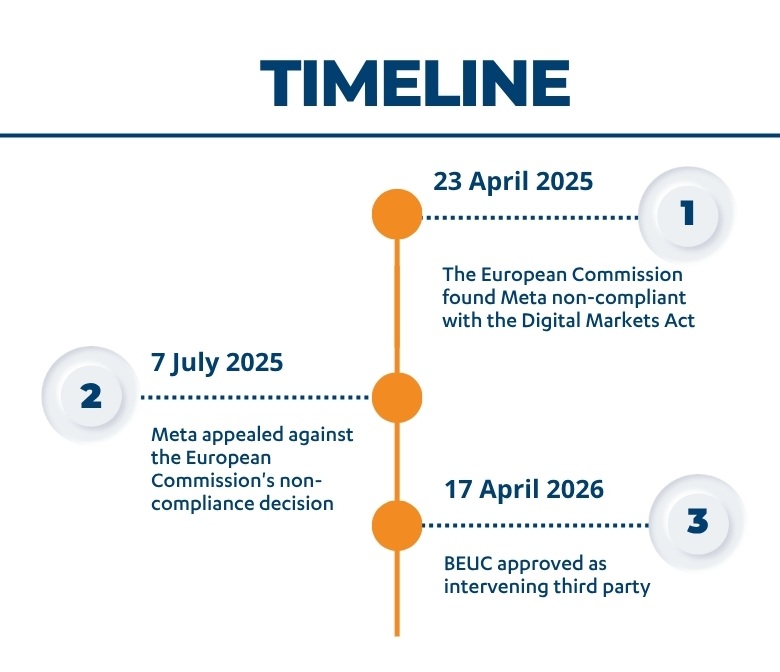
Meta, however, rolled out a pay-or-consent mechanism in preparation of the DMA which only offered consumers a binary choice: either pay a monthly subscription to not see ads, or accept Meta’s full processing practices for ad purposes. The Commission reached a Non-Compliance Decision, which included ordering Meta to enter into compliance and to pay a €200m fine.
Meta appealed the Commission’s Non-Compliance Decision, which has meant that the EU’s General Court will review the decision. On the basis that Meta did not provide consumers with a legally acceptable alternative and could therefore not consent, BEUC applied to intervene in the court proceedings in support of the Commission.
BEUC was approved as an intervening third party in the case (Case T-435/25). We intend to provide the consumer voice in showing that Meta breached the DMA and harmed consumers by neither obtaining valid consent, nor offering a less personalised but equivalent alternative.
Separately, and beyond our work on the DMA, BEUC has coordinated two actions with its members against Meta’s practices around pay-or-consent, one on the basis of consumer law, the other on data protection law.
- Press release: Commission decisions against Apple and Meta necessary to bring more choice to consumers in digital markets (23 April 2025).
- Analysis Implementation by Meta, Apple, Google, Amazon, Bytedance and Microsoft of their obligations under the DMA (2 September 2024).
- Analysis of Meta’s 2026 changes to its consent-for-ads mechanism against EU law (March 2026).
Contact Card

Alexandre Biard
Manager, Enforcement, Competition and Consumer rights

Sébastien Pant
Senior Officer - Competition and Digital Enforcement

Sandra Post
Communications Officer