Related Publications
Position papers
Available in
English
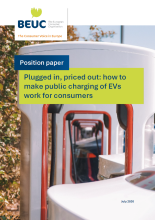
Consumer-friendly charging is instrumental for the mass adoption of electric vehicles (EVs). As well as binding deployment targets for public charging infrastructure, the EU’s Alternative Fuels Infrastructure Regulation (AFIR) includes important requirements on price transparency and payment methods.
However, despite these requirements, public charging across Europe still has structural problems that undermine consumer trust: an opaque, multi-layered pricing system hindering comparison, billing complexity that makes costs impossible to predict, local monopolies and payment methods that remain inaccessible to many.
BEUC calls on the European Commission and co-legislators to close AFIR regulatory gaps and address the underlying market failures, including market concentration, that keep public charging expensive and difficult to use.
However, despite these requirements, public charging across Europe still has structural problems that undermine consumer trust: an opaque, multi-layered pricing system hindering comparison, billing complexity that makes costs impossible to predict, local monopolies and payment methods that remain inaccessible to many.
BEUC calls on the European Commission and co-legislators to close AFIR regulatory gaps and address the underlying market failures, including market concentration, that keep public charging expensive and difficult to use.
Reports
Available in
English
This policy note is based on an analytical study carried out for Transport & Environment (T&E) and the European Consumer Organisation (BEUC) in the context of the upcoming review of the Alternative Fuels Infrastructure Regulation (AFIR). The objective of the study is to assess how AFIR can better ensure a transparent, predictable and user-friendly charging experience across Europe. The analysis focuses specifically on price transparency, comparability of charging options, and the visibility of all price components before and after a charging session in order to avoid eventual excessive prices.
Reports
Available in
English
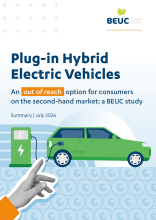
Based on the selection of 600 popular and widely available secondhand PHEVs (100 per country) retrieved from major resale websites, this report presents the choice of Plug-in Hybrid Vehicles (PHEVs) offered to consumers on the second-hand market, in six European countries: France, Germany, Italy, Poland, Belgium, and Slovenia. By focusing on countries with strong second-hand car markets, but different tax policies on PHEVs, car segments and average fleet mileage, BEUC identifies the most common PHEV models that enter the used car market and the price trends in different countries.
The full report referenced in this summary can be found here.