




Position paper
Available in
English
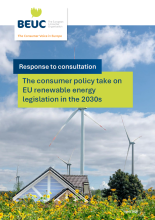
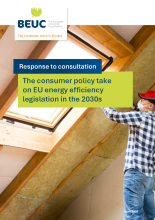
Heating and cooling are one of the largest expenses for European households. To bring down energy bills, cut our dependency on fossil fuels and decarbonise the sector, we need to change how we heat and cool our homes. For consumers to make this shift, the EU should set out a clear strategy that speeds up the uptake of heat pumps, expands renewable-based district heating, and accelerates housing renovations.
Position paper
Available in
English
People have been locked into an energy and transport system fundamentally based on (imported) fossil fuels. This has a negative impact on the planet, our health, wallets, and geopolitical security. Change is afoot to decarbonise our economy, influenced by clear EU policies in energy, product design, and the automotive sector. BEUC research has consistently shown that electrification in many consumer areas – cars, cooling, heating – is the most affordable option.
Position paper
Available in
English
The energy market is too complex and often out of reach for most households to offer consumers fair opportunities to engage. Recent reforms of EU energy law give consumers new rights and protections, but these will only work if properly implemented, monitored, supported, and enforced. BEUC is therefore strongly supportive of the Citizens Energy Package and calls on the European Commission for an ambitious initiative that should result in lower energy bills. All consumers must be properly protected and able to exercise their rights, access renewable energy, and take advantage of innovative energy contracts and schemes.
Below, we summarise the key recommendations that are needed to turn consumers rights into
concrete actions. The measures and best practices are explained in more detail in the respective
sections of the consultation response.
Below, we summarise the key recommendations that are needed to turn consumers rights into
concrete actions. The measures and best practices are explained in more detail in the respective
sections of the consultation response.
Position paper
Available in
English
To make a well-informed choice when buying a car (new or second-hand), consumers need clear and accurate information about a car’s real-world fuel or electricity consumption, its overall environmental impact or incentives available in their country. With many new models and powertrains available along with evolving purchase habits, current EU rules adopted in 1999 and are now completely outdated.