Latest News
Logo

Position papers
Available in
English
Housing has become one of the top concerns for European consumers, and for good reason: decent, safe and affordable homes are increasingly out of reach. The issue is straightforward: supply of this kind of housing is failing to meet demand.
Several avenues exist to speed up procedures, notably stepping up the renovation rates. However, faster delivery cannot come at the expense of consumer protection.
To address the housing crisis, this issue should be addressed at EU level. That is one of the reasons we welcomed the recent publication of the Affordable Housing Act.
At this stage, the precise scope of the package remains uncertain. In the absence of further clarity, BEUC sets out in this paper the principles that should guide the Commission’s work, as well as the red lines that must not be crossed from a consumer perspective.
Several avenues exist to speed up procedures, notably stepping up the renovation rates. However, faster delivery cannot come at the expense of consumer protection.
To address the housing crisis, this issue should be addressed at EU level. That is one of the reasons we welcomed the recent publication of the Affordable Housing Act.
At this stage, the precise scope of the package remains uncertain. In the absence of further clarity, BEUC sets out in this paper the principles that should guide the Commission’s work, as well as the red lines that must not be crossed from a consumer perspective.
Reports
Available in
English
Consumer reality check report: how best to ensure support reaches consumers that need it
Financing instruments such as grants or loans exist to help consumers renovate their homes to make them more energy efficient as well as more affordable, healthier, and comfortable. Yet, administrative hurdles and complex procedures often discourage or prevent households from doing so. Moreover, financial support is often insufficient or out of reach for many consumers.
This report synthesises insights and assessments of 14 national consumer organisation across Europe on financing instruments for consumers in the energy sector.
Financing instruments such as grants or loans exist to help consumers renovate their homes to make them more energy efficient as well as more affordable, healthier, and comfortable. Yet, administrative hurdles and complex procedures often discourage or prevent households from doing so. Moreover, financial support is often insufficient or out of reach for many consumers.
This report synthesises insights and assessments of 14 national consumer organisation across Europe on financing instruments for consumers in the energy sector.

Press releases
Available in
English
The EU today published a series of proposals to decarbonise Europe’s economy and reform energy bills. For consumers, this can mean more affordable bills and easier participation in the energy transition.

Reports
Available in
English
The CLEAR-HP project helped to accompany consumers across Europe throughout the whole purchasing journey of switching from a fossil fuel boiler to a heat pump.
The project aimed to raise consumer awareness, build confidence in heat pump technology, and ultimately enhance both the energy efficiency and comfort of people’s homes.
At its core, national consumer organisations in seven European countries (Belgium, Bulgaria, Italy, Slovenia, Slovakia, Spain and Portugal) organised collective purchase campaigns for independently-tested heat pumps.
Participants benefited from advantageous purchase and installation packages that included consumer support and workshops throughout the process.
As the project comes to an end, this report takes an in-depth look at what the partners managed to achieve and proposes some key takeaways for policymakers.
The project aimed to raise consumer awareness, build confidence in heat pump technology, and ultimately enhance both the energy efficiency and comfort of people’s homes.
At its core, national consumer organisations in seven European countries (Belgium, Bulgaria, Italy, Slovenia, Slovakia, Spain and Portugal) organised collective purchase campaigns for independently-tested heat pumps.
Participants benefited from advantageous purchase and installation packages that included consumer support and workshops throughout the process.
As the project comes to an end, this report takes an in-depth look at what the partners managed to achieve and proposes some key takeaways for policymakers.

Reports
Available in
English
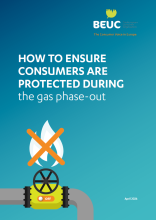
The days of gas as a home-heating solution will eventually come to an end, as consumers move to cleaner options like heat pumps.
This will mean the gas network will become increasingly unused with the remaining consumers connected to it having to pay for it. Without public support, this will mean significant costs for consumers, according to a new report from BEUC, The European Consumer Organisation.
The rising costs of maintaining the gas network will also disproportionately impact those least able to switch to cleaner heating options (for example, vulnerable consumers or tenants).
This will mean the gas network will become increasingly unused with the remaining consumers connected to it having to pay for it. Without public support, this will mean significant costs for consumers, according to a new report from BEUC, The European Consumer Organisation.
The rising costs of maintaining the gas network will also disproportionately impact those least able to switch to cleaner heating options (for example, vulnerable consumers or tenants).

Press releases
Available in
English
The European Commission today published its Accelerate EU plan, a much-needed set of measures to help consumers through the current fossil fuel crisis and beyond.
Under the plans, the Commission will legislate to reduce electricity taxes and network charges for all consumers. This would have a tangible impact on consumers’ energy bills: lowering taxes alone could lead to bill reductions of around 14%. Assistance will also be given to EU governments on how to provide targeted support to consumers who need it and promote social leasing schemes for electric cars.
Under the plans, the Commission will legislate to reduce electricity taxes and network charges for all consumers. This would have a tangible impact on consumers’ energy bills: lowering taxes alone could lead to bill reductions of around 14%. Assistance will also be given to EU governments on how to provide targeted support to consumers who need it and promote social leasing schemes for electric cars.
Position papers
Available in
English
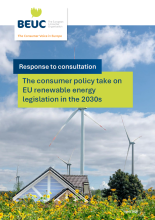
Continuing Europe’s shift to renewable energy is indispensable to better protect households against bill shocks caused by fossil fuels. This also protects the planet and improves people’s quality of life.
Position papers
Available in
English
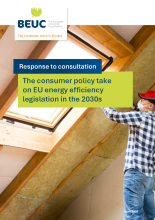
Improving energy efficiency is essential for consumers to lower their energy bills. Progress has been made, but it remains slow, with too few homes renovated and cleaner heating solutions still out of reach for many consumers. What is needed is clear, tailor-made guidance, adequate financial help, and stronger protection and support, in particular for the most vulnerable households.