
Logo

Letters
Available in
English
As smart glasses become increasingly available to consumers across Europe, concerns are growing about their impact on privacy, surveillance and fundamental rights. In a letter to Executive Vice-President Henna Virkkunen, Commissioner McGrath and the European Data Protection Board Chair, Anu Talus, BEUC warns that wearable devices equipped with hidden cameras and AI-powered features could normalise covert surveillance in everyday life. Consumer organisations are calling on the EU to assess the risks, strengthen safeguards, and ensure that innovation does not come at the expense of people's privacy, safety and control over their personal data.
Tools
Available in
English
How can a closer EU-Canada relationship deliver for consumers? This Consumer Checklist from BEUC and the Consumers Council of Canada sets out priorities for stronger cooperation on safer products, affordable clean technologies, easier travel, cross-border payments, online consumer protection and the right to repair. This cooperation should be structured through an informal consumer dialogue between Canada and EU officials.
It also calls on the EU and Canada to preserve high food-safety standards, protect digital rights and data protection, support trustworthy AI, remove Investor-State Dispute Settlement from CETA, and ensure transparency and meaningful engagement with consumer organisations
It also calls on the EU and Canada to preserve high food-safety standards, protect digital rights and data protection, support trustworthy AI, remove Investor-State Dispute Settlement from CETA, and ensure transparency and meaningful engagement with consumer organisations

Press releases
Available in
English
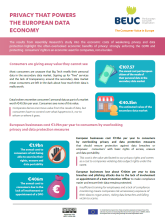
New research from Assembly Research, commissioned by BEUC, shows that privacy has real economic value and that strong enforcement of the GDPR benefits not only consumers, but businesses and the wider European economy. Strong rights help build the trust and confidence that a healthy digital economy depends on.
Tools
Available in
English
The results from Assembly Research’s study into the economic costs of weakening privacy and data
protection highlight the often-overlooked economic benefits of privacy: strongly enforcing the GDPR and
protecting consumers’ rights is an economic asset for companies, not a burden.
protection highlight the often-overlooked economic benefits of privacy: strongly enforcing the GDPR and
protecting consumers’ rights is an economic asset for companies, not a burden.
Letters
Available in
English
Together, the undersigned organisations, are sounding the alarm about the growing proliferation of scams on social media platforms. We call on the relevant EU and national authorities to ensure that tech platforms fully comply with their obligations under the Digital Services Act (DSA).
Letters
Available in
English
Following the latest discussions in Council on the Digital Omnibus, BEUC would like to express its concern regarding the latest compromise proposals put forward by the Irish Presidency. BEUC considers that the current proposals under discussion would represent a significant rollback of EU protections for personal data and fundamental rights, which stand to have a clear negative impact on consumers.
Letters
Available in
English
In this joint statement, nine civil society organisations including the European Consumer Organisation (BEUC) call EU policymakers to safeguard patients' data protection in the Digital Omnibus.

Press releases
Available in
English
The Irish Data Protection Commission has fined Google €403 million for its location-tracking activities and ordered the company to comply with the EU's GDPR within 6 months. This is an important decision, close to eight years after a series of complaints consumer organisations from the BEUC network issued against Google.