Latest News
Logo

Position papers
Available in
English
EU energy and climate legislation sets the pace for decarbonising our economy. Some of these laws contain EU targets. The governance law helps Member States deliver these targets and defines reporting obligations. This should result in consumers benefitting from lower bills, a better quality of life, and a future for our planet. Practically this means more renewable energy, less imports of volatile fossil fuels, continuous efforts to use energy more efficiently, the availability of sustainable products that can be recognised via clear labels, a variety of green mobility choices, and a future where healthy and sustainable foods are accessible and affordable.
Press releases
Available in
English
The European Commission published today some much-needed measures to help keep energy bills affordable in its Citizens Energy Package, which aims to help EU countries implement existing energy legislation. The move comes just as Europe is potentially looking at another energy price crisis caused by fossil fuel dependence, as in 2022.
Reports
Available in
English
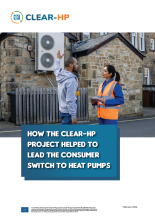
The CLEAR-HP project helped to accompany consumers across Europe throughout the whole purchasing journey of switching from a fossil fuel boiler to a heat pump. The project aimed to raise consumer awareness, build confidence in heat pump technology, and ultimately enhance both the energy efficiency and comfort of people’s homes.
At its core, national consumer organisations in seven European countries (Belgium, Bulgaria, Italy, Slovenia, Slovakia, Spain and Portugal) organised collective purchase campaigns for independently-tested heat pumps. Participants benefited from advantageous purchase and installation packages that included consumer support and workshops throughout the process.
At its core, national consumer organisations in seven European countries (Belgium, Bulgaria, Italy, Slovenia, Slovakia, Spain and Portugal) organised collective purchase campaigns for independently-tested heat pumps. Participants benefited from advantageous purchase and installation packages that included consumer support and workshops throughout the process.
Reports
Available in
English
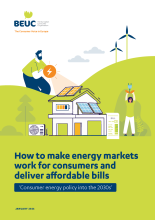
This BEUC report takes stock of Europe’s energy markets and sets out key areas for improvement from a consumer perspective, from heat pumps to energy bills and everything in between. This paper details BEUC’s energy policy priorities for consumers into the 2030s, mapping out what is currently working well and what still needs to be improved. BEUC's recommendations relate to important EU initiatives such as the Affordable Energy Action Plan, Affordable Housing Plan and the broader 2030 Consumer Agenda.
Position papers
Available in
English
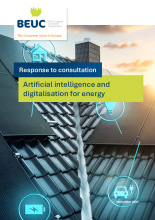
Energy systems are increasingly connected with digital tools and automation becoming more common in consumers’ homes. This digitalisation can be beneficial to consumers. It can help make their energy system more efficient and as consequence lower their energy bills. For example, in order to be able to fully benefit from the advantages of a flexible system , consumers need to have access to digital tools and services that provide real time data. Also, the proliferation of online comparison tools and switching services can help consumers finding an offer that better suits their needs and to switch provider quickly.
Digitalisation can also contribute to the green transition by making it easier for consumers to use and share renewable energy. Consumers with solar panels will benefit from digitalisation as it will help them to optimise the use of electricity generated and, for instance, share the surplus with neighbours.
However, the spreading of digitalisation and AI in the energy sector also comes with important shortcomings that consumers need to be protected from. The misuse of digital tools can undermine consumers’ fundamental rights to privacy and data protection. Poorly cybersecure smart meters could have an impact on peoples’ finances and even health. The use of AI by energy providers could also result in discriminatory practices. Therefore, while BEUC is supportive of the digitalisation of the energy sector, this can only happen if certain conditions are fulfilled and with a high level of consumer protection.
In the paper, we provide a list of recommendations that EU and national policymakers as well as regulators need to bear in mind when considering the further digitalisation of the energy sector.
Digitalisation can also contribute to the green transition by making it easier for consumers to use and share renewable energy. Consumers with solar panels will benefit from digitalisation as it will help them to optimise the use of electricity generated and, for instance, share the surplus with neighbours.
However, the spreading of digitalisation and AI in the energy sector also comes with important shortcomings that consumers need to be protected from. The misuse of digital tools can undermine consumers’ fundamental rights to privacy and data protection. Poorly cybersecure smart meters could have an impact on peoples’ finances and even health. The use of AI by energy providers could also result in discriminatory practices. Therefore, while BEUC is supportive of the digitalisation of the energy sector, this can only happen if certain conditions are fulfilled and with a high level of consumer protection.
In the paper, we provide a list of recommendations that EU and national policymakers as well as regulators need to bear in mind when considering the further digitalisation of the energy sector.
Position papers
Available in
English
People have been locked into an energy and transport system fundamentally based on imported fossil fuels. This has a negative impact on the planet, our health, wallets, and geopolitical security. Change is afoot to decarbonise our economy, influenced by clear EU policies in energy, the automotive sector, and product design. A well-managed transition to affordable, clean, and diversified (localised) energy is a major component of improving Europe’s security.
Position papers
Available in
English
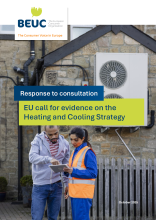
Heating and cooling are one of the largest expenses for European households. To bring down energy bills, cut our dependency on fossil fuels and decarbonise the sector, we need to change how we heat and cool our homes. For consumers to make this shift, the EU should set out a clear strategy that speeds up the uptake of heat pumps, expands renewable-based district heating, and accelerates housing renovations.
Position papers
Available in
English
People have been locked into an energy and transport system fundamentally based on (imported) fossil fuels. This has a negative impact on the planet, our health, wallets, and geopolitical security. Change is afoot to decarbonise our economy, influenced by clear EU policies in energy, product design, and the automotive sector. BEUC research has consistently shown that electrification in many consumer areas – cars, cooling, heating – is the most affordable option.
Position papers
Available in
English
The energy market is too complex and often out of reach for most households to offer consumers fair opportunities to engage. Recent reforms of EU energy law give consumers new rights and protections, but these will only work if properly implemented, monitored, supported, and enforced. BEUC is therefore strongly supportive of the Citizens Energy Package and calls on the European Commission for an ambitious initiative that should result in lower energy bills. All consumers must be properly protected and able to exercise their rights, access renewable energy, and take advantage of innovative energy contracts and schemes.
Below, we summarise the key recommendations that are needed to turn consumers rights into
concrete actions. The measures and best practices are explained in more detail in the respective
sections of the consultation response.
Below, we summarise the key recommendations that are needed to turn consumers rights into
concrete actions. The measures and best practices are explained in more detail in the respective
sections of the consultation response.
Reports
Available in
English
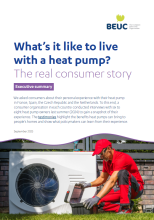
We asked consumers about their personal experience with their heat pump in France, Spain, the Czech Republic and the Netherlands. To this end, a consumer organisation in each country conducted interviews with six to eight heat pump owners last summer (2024) to gain a snapshot of their experience.
The testimonies highlight the benefits heat pumps can bring to people’s homes and show what policymakers can learn from their experience.
This is the executive summary of that exercise. To read the full report, click here.
The testimonies highlight the benefits heat pumps can bring to people’s homes and show what policymakers can learn from their experience.
This is the executive summary of that exercise. To read the full report, click here.