
Latest News
Logo


News
On 29 June 2026, EU Member States appointed The European Consumer Organisation's (BEUC) Director General, Agustín Reyna, as a member of the Management Board of the European Food Safety Authority (EFSA).

Tools
Available in
English
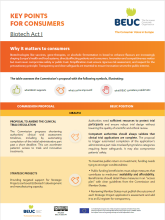
Biotechnologies like vaccines, gene-therapies, or alcoholic fermentation in bread to enhance flavours are increasingly shaping Europe’s health and food systems, directly affecting patients and consumers. Innovation and competitiveness matter but must never compromise safety or public trust. Simplification must ensure rigorous risk assessment, and respect for the precautionary principle. Transparency and clear safeguards are essential to ensure innovation serves the public interest.
Tools
Available in
English
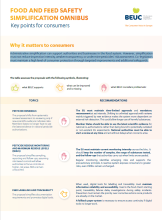
The Food and Feed Safety Simplification Omnibus aims at giving authorities and businesses in the food system more flexibility, particularly on pesticides, mad cow disease, feed labelling, inspections and border controls. However, simplification must not reduce inspection intensity, weaken transparency, or undermine pesticides’ risk assessment. Co-legislators must maintain a high level of consumer protection through targeted improvements and additional safeguards.
Tools
Available in
English
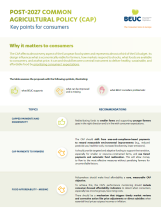
The CAP affects almost every aspect of the European food system and represents almost a third of the EU budget. Its design influences what is economically viable for farmers, how markets respond to shocks, what foods are available to consumers, and at what price. It can and should become a central instrument to deliver healthy, sustainable, and affordable food by prioritising consumers’ expectations.
Position papers
Available in
English
EU energy and climate legislation sets the pace for decarbonising our economy. Some of these laws contain EU targets. The governance law helps Member States deliver these targets and defines reporting obligations. This should result in consumers benefitting from lower bills, a better quality of life, and a future for our planet. Practically this means more renewable energy, less imports of volatile fossil fuels, continuous efforts to use energy more efficiently, the availability of sustainable products that can be recognised via clear labels, a variety of green mobility choices, and a future where healthy and sustainable foods are accessible and affordable.

Press releases
Available in
English
EU institutions agreed to ban meat-related names for vegetarian and vegan products arguing they create confusion for consumers. This makes little sense and consumers say otherwise.
Position papers
Available in
English
The Common Agricultural Policy (CAP) affects almost every aspect of the European food system. Its design influences what is economically viable for farmers, how markets respond to shocks, what foods are available to consumers and at what price. Consumers recognise the importance of income support for farmers, but they want the CAP to go beyond agricultural policies.
Tools
Available in
English
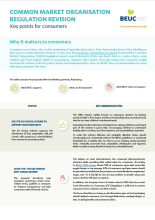
BEUC key points for consumers on the Common Market Organisation Regulation Revision
Reports
Available in
English
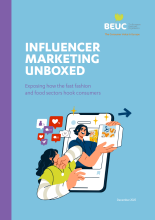
Influencer marketing is everywhere and unavoidable for anyone on social media due to the high volume of content and boundless creativity of social media influencers. Between March and September 2025, 14 BEUC consumer organisations from 12 countries monitored about 650 posts and videos of social media influencers on TikTok, Instagram, YouTube and Snapchat.
Although influencer marketing is present in nearly all sectors, this evidence-gathering focused on posts and videos promoting unhealthy food advertising and fast fashion as they are sectors where consumers are likely to be particularly at risks. Evidence confirms the widespread use of hidden advertising practices and how influencers appeal to emotions to shape consumers’ preferences. It also shows how brands use influencer marketing to give a positive spin to their reputation in the eyes of consumers, in particular the youngest ones.
As we identified in 2023, current EU law is only partially able to tackle the problems posed by influencer marketing and needs to be updated.1 It must clarify the responsibilities of the different actors operating in the influencer marketing environment - from influencers and their agencies to brands and online platforms. This report provides additional evidence supporting ongoing policy discussions at EU and national level. This is particularly the case for the EU Digital Fairness Act and the evaluation of the Audiovisual Services Media Directive, both expected in 2026.
Although influencer marketing is present in nearly all sectors, this evidence-gathering focused on posts and videos promoting unhealthy food advertising and fast fashion as they are sectors where consumers are likely to be particularly at risks. Evidence confirms the widespread use of hidden advertising practices and how influencers appeal to emotions to shape consumers’ preferences. It also shows how brands use influencer marketing to give a positive spin to their reputation in the eyes of consumers, in particular the youngest ones.
As we identified in 2023, current EU law is only partially able to tackle the problems posed by influencer marketing and needs to be updated.1 It must clarify the responsibilities of the different actors operating in the influencer marketing environment - from influencers and their agencies to brands and online platforms. This report provides additional evidence supporting ongoing policy discussions at EU and national level. This is particularly the case for the EU Digital Fairness Act and the evaluation of the Audiovisual Services Media Directive, both expected in 2026.