
Latest News
Logo

Reports
Available in
English
Consumers spend more time online and increasingly rely on digital payment services in their daily lives. As their digital presence grows, so do fraudulent practices, with online advertising emerging as a major vector for scams. Whether watching videos, following friends, scrolling or reading the news, consumers are routinely exposed to increasingly sophisticated fraud schemes, leading not only to financial harm – i.e. in 2024, consumers suffered financial losses up to EUR 4.2 billion – but also to a loss of trust in digital and financial markets.

Letters
Available in
English
BEUC – The European Consumer Organisation, wrote to the European Commission to inform that, together
with 29 consumer organisations from 27 countries, we are filing complaints against Meta, TikTok, and Google with the European Commission and the competent Digital Services Coordinators, pursuant to Article 53 of EU Regulation 2022/2065 (the Digital Services Act- DSA).
with 29 consumer organisations from 27 countries, we are filing complaints against Meta, TikTok, and Google with the European Commission and the competent Digital Services Coordinators, pursuant to Article 53 of EU Regulation 2022/2065 (the Digital Services Act- DSA).
Tools
Available in
English
BEUC, The European Consumer Organisation, together with 13 consumer groups from 13 countries (Albania, Austria, Belgium, Bulgaria, Denmark, France, Germany, Poland, Portugal, Slovakia, Slovenia, Spain and the Netherlands), conducted an evidence-gathering to document the widespread financial scams on Meta, TikTok and Google as well as the limited corrective measures platforms take to prevent their circulation. The screenshots were taken between December 2025 and March 2026. Consumer groups collected 893 examples.
Reports
Available in
English
BEUC, The European Consumer Organisation, together with 13 consumer groups from 13 countries (Albania, Austria, Belgium, Bulgaria, Denmark, France, Germany, Poland, Portugal, Slovakia, Slovenia, Spain and the Netherlands), conducted an evidence-gathering to document the widespread financial scams on Meta, TikTok and Google as well as the limited corrective measures platforms take to prevent their circulation. The screenshots were taken between December 2025 and March 2026. Consumer groups collected 893 examples. This annex does not intend to provide the exhaustive list of ads, but highlights key examples collected per organisation.

Press releases
BEUC, the European Consumer Organisation, regrets that the final AI omnibus adopted early this morning, aimed to simplify AI rules to boost competitiveness, instead creates a less safe digital environment for consumers as it delays key provisions in the AI Act and creates dangerous loopholes in the scope of the law.
Letters
Available in
English
BEUC, the European Consumer Organisation, together with 3 organisations representing civil society, consumers and children's rights wrote to the EU Commission, the Cyprus EU Council Presidency and Members of the European Parliament to express our concerns about current proposals in the AI Omnibus that would weaken the scope and effectiveness of the EU Artificial Intelligence Act.
Tools
Available in
English
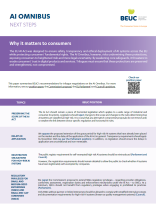
The EU AI Act was designed to ensure safety, transparency and ethical deployment of AI systems across the EU while protecting consumers’ fundamental rights. The AI Omnibus, however, risks undermining these protections, exposing consumers to heightened risks and more legal uncertainty. By weakening core safeguards, it threatens to erode consumers’ trust in digital products and services. Trilogues must ensure that these protections are preserved and strengthened, not compromised.
This paper summarises BEUC’s recommendations for trilogue negotiations on the AI Omnibus. For more information, see our position paper, the Commission’s proposal, the EU Parliament’s and Council’s positions.
This paper summarises BEUC’s recommendations for trilogue negotiations on the AI Omnibus. For more information, see our position paper, the Commission’s proposal, the EU Parliament’s and Council’s positions.
Letters
Available in
English
BEUC, the European Consumer Organisation, together with 33 organisations and individuals representing civil society, consumers, doctors, hospitals and healthcare services, conformity assessment bodies (CABs), and academia, wrote to the Commission, the Cyprus EU Council Presidency and Members of the European Parliament to express our concerns about current proposals in the AI Omnibus that would weaken the scope and effectiveness of the EU Artificial Intelligence Act.
Our main concerns is with the removal of Annex I from the AI Act. This change would create a significant loophole, excluding a wide range of industrial and consumer AI systems from the direct scope of the AI Act.
Our main concerns is with the removal of Annex I from the AI Act. This change would create a significant loophole, excluding a wide range of industrial and consumer AI systems from the direct scope of the AI Act.
Press releases
Available in
English
Following today’s adoption of the European Parliament’s position on the AI omnibus and ahead of interinstitutional negotiations, BEUC calls upon the EU institutions and national governments to ensure that critical safeguards to protect consumers and their fundamental rights are kept in the AI Act.